
RUAC Platform
The advent of “smart” inverter systems and batteries is revolutionizing energy delivery for marine and overland mobile platforms as well as off-grid power delivery for emergencies and remote sites. However, most of these system use proprietary control and monitoring software that does not integrate well across vendors making it harder to automate functions based on signals from diverse sensors to effectively manage energy usage, and optimize utilization of renewable sources. Additionally, industrial systems lack flexibility and ease of use, and are way too costly and complex for small companies, individual enthusiasts and non-profits. Resilient Universal Automation and Control (RUAC) is a software platform that leverages Open Source Software (OSS), open protocols and IT industry standard monitoring, alerting and automation tools and techniques in innovative ways to overcome these limitations.
Overview
The advent of “smart” inverter systems and batteries is revolutionizing energy delivery for marine and overland mobile platforms as well as off-grid power delivery for emergencies and remote sites. However, most of these system use proprietary control and monitoring software that does not integrate well across vendors making it harder to automate functions based on signals from diverse sensors to effectively manage energy usage, and optimize utilization of renewable sources. Additionally, industrial systems lack flexibility and ease of use, and are way too costly and complex for small companies, individual enthusiasts and non-profits. Resilient Universal Automation and Control (RUAC) is a software platform that leverages Open Source Software (OSS), open protocols and IT industry standard monitoring, alerting and automation tools and techniques in innovative ways to overcome these limitations.
RUAC Architecture
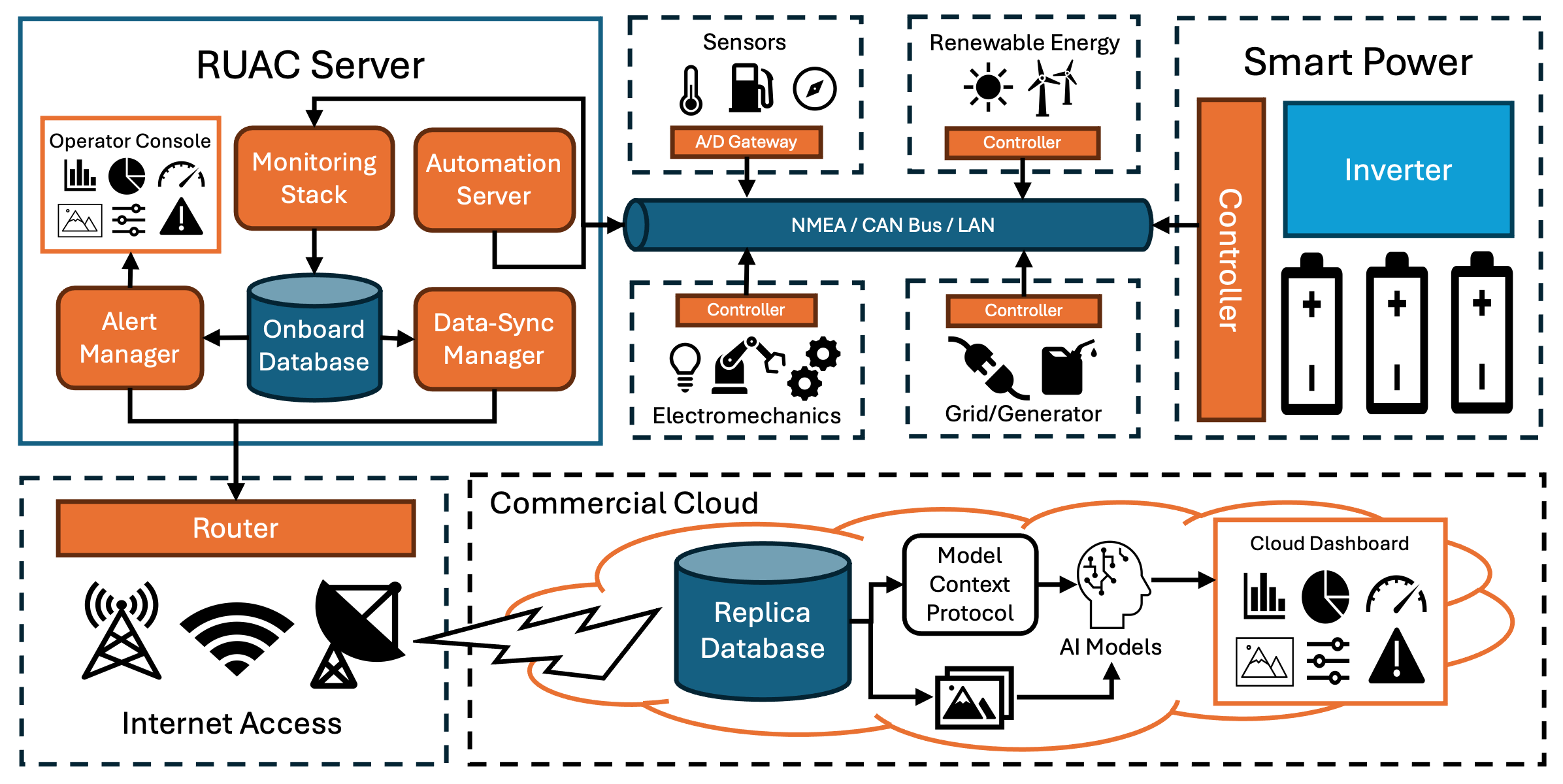
The following diagram illustrates the RUAC architecture and how it integrates with onboard power and sensors as well as with the internet and cloud-based software:
RUAC Server Components
The core component of RUAC is a collection of integrated open-source and custom software called the RUAC Server. The server is automatically deployed using lightweight containers that can run on any compute available including Windows or MacOS mini-PCs, like the Mac mini, or even single-board computers running Linux, like the Raspberry Pi. This enables the RUAC Server to operate efficiently without increasing energy requirements and be integrated with any existing navigation and control desktops.
Below is a description of the RUAC Server components:
Monitoring Stack: The RUAC server leverages an open-source monitoring stack that is optimized to process and store time-series data from a variety of standard or custom exporters as well as data received via TCP/IP Ethernet or Controller Area Network (CAN) bus using open protocols. This enables it to efficiently monitor diverse devices, like Victron Energy systems using VE.bus protocol or other sensors using either custom A/D gateways or controllers that support CAN Bus or NEMA standards.
Automation Server: The Automation Server responds to events in time series data according to pre-defined rules and thresholds and issues automation commands via TCP/IP Ethernet or CAN Bus. This allows RUAC to base automation commands on data from diverse sensors in order to optimize usage of renewable energy while at the same time keeping critical systems operational. For example, when battery charge falls below a certain threshold, the RUAC automation server can issue a CAN Bus command for a custom Arduino-based microcontroller to begin a start-up sequence for a diesel generator.
Onboard Database: The Onboard Database stores an indexed log of time-series metrics that are used for running analytics, building real-time dashboards, and triggering alerts and automation commands. Time series data is stored on-disk using a highly-efficient format for rapid access and to minimize storage requirements; however, it can also be archived to either onboard remote storage (I.e., Network Attached Storage or NAS) or to the cloud based on flexible rules to off-load “colder” data from analytics. (See Data-Sync Manager below). In addition, the onboard database can index video feeds, imagery or other media stored externally to augment dashboards or for AI-based analysis.
Alert Manager: The Alert Manager issues alerts based on time-series metrics when predefined conditions or thresholds are exceeded. Alerts can be push notifications either on the local host or mobile devices connected to the local network. The Alert Manager can also issue email and/or Short Message Service (SMS) notifications using any available Internet connection (either WiFi, cellular or satellite) when available.
Data-Sync Manager: The Data-Sync Manager controls synching of data between the Onboard Database and cloud-based replicas. The status, bandwidth and throughput of available Internet connections are constantly monitored enabling the Data-Synch Manager to optimize data transfers. Additionally, the Data-Synch Manager uses pre-defined rules to prioritize transfers when Internet connectivity is constrained so that critical information is available in the cloud for remote management and control while lower priority historical data is eventually aggregated for analytics.
Onboard Dashboards: The open-source monitoring stack integrates seamlessly with custom configurable web-based dashboards for real-time alerting and control. Dashboards are published using a web app that can be accessed via any web browser either on the local host (if connected to a display and input devices) or mobile devices and smart displays connected to the local network. Dashboards can also integrate video feeds and other types of streaming media enabling them to display data from web cameras or other sensors that do not use supported protocols.
Cloud Connectivity
The RUAC cloud-based database replicas facilitate interaction between onboard systems and the cloud without requiring constant Internet connectivity. As mentioned above, the RUAC Data-Sync Manager prioritizes data transfer based on available connectivity and bandwidth ensuring critical information is available as soon as possible and eventually creating a historical backlog of all data for analysis. In addition, selected media from remote storage can also be synched to the cloud for further analysis whenever sufficient bandwidth and throughput are available. The cloud-based replicas can be used directly to power web-based dashboards for remote monitoring and control using the same tools and protocols available for onboard dashboards.
In addition, cloud-based replicas enable analysis by powerful commercial AI-based models to leverage capabilities like computer-vision and natural language processing (NLP). Cloud-based Large Language Models (LLMs, like ChatGPT) can use custom or open-source Model Context Protocols (MCP) to answer natural language queries based on time-series data via a chat interface. For example, users can ask a chatbot “What is my average nightly energy consumption?” and get an immediate answer from historical time-series data. Additionally, AI-inference on media or archived video can be used to issue automation commands. For example, a computer-vision model trained to detect snowfall from imagery can be used to determine when to activate heaters to keep antennas and solar arrays clear without expending more energy than needed.
Current Status
Infrastructure is currently being installed aboard a 32’ trawler test bed. Development of the prototype RUAC Minimum Viable Prototype (MVP) software is underway. A beta release of RUAC is planned for early 2027. Click below for more information.